One of Five Estuaries key goals is to help young people understand the vital role that renewable energy — specifically offshore wind — plays in the UK’s journey toward a sustainable future. By engaging with students at these pivotal stages of their education, our aim is to introduce them to the concept of offshore wind energy early on, sparking curiosity and interest in careers that many might not otherwise encounter until later in life.
At the Tendring Primary School Careers Fair, the team introduced over 240 Year 6 pupils from nine primary schools within the Tendring district to the basics of offshore wind. Mad Science supported the team, with their ‘Wonderful Windmills’ activity, demonstrating how turbines are built and generate energy. By engaging at this age, introducing students to renewable energy helps lay a foundation that can guide their choices through school and beyond, showing them how the subjects they’re learning today can lead to exciting, impactful careers tomorrow.
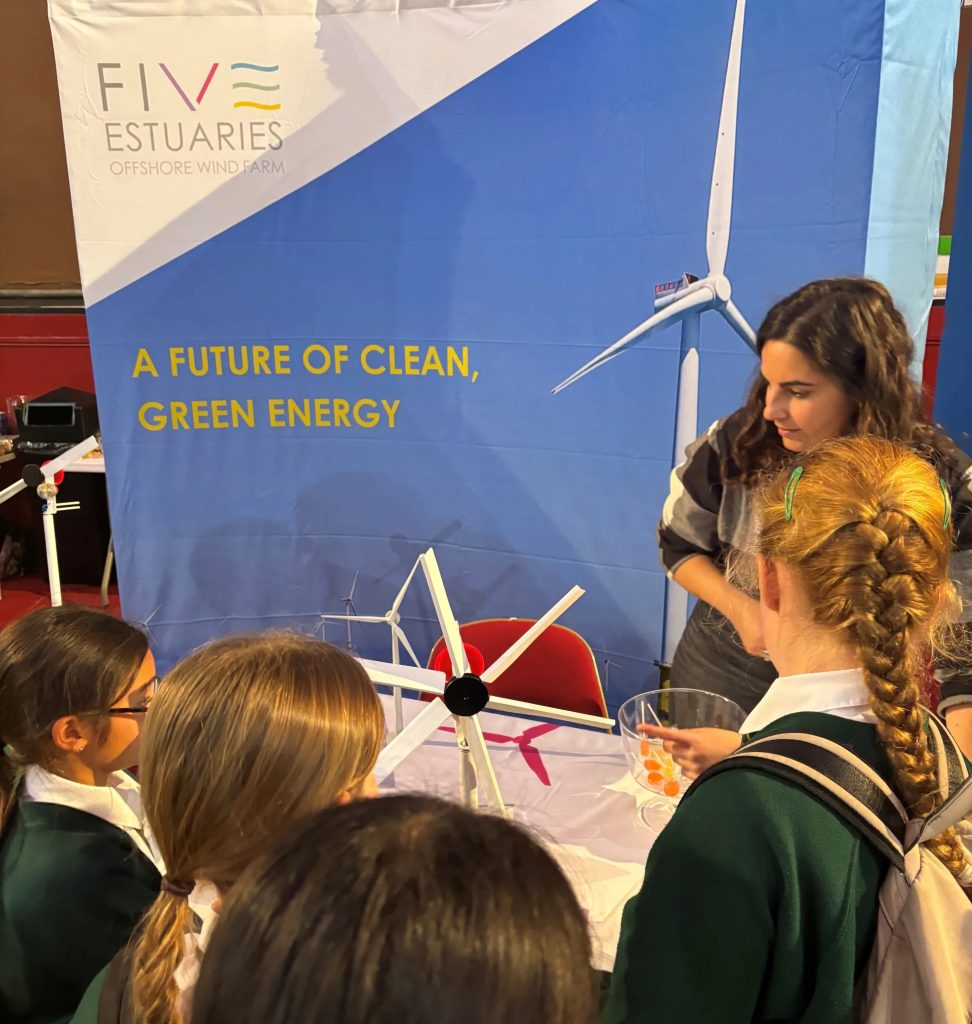
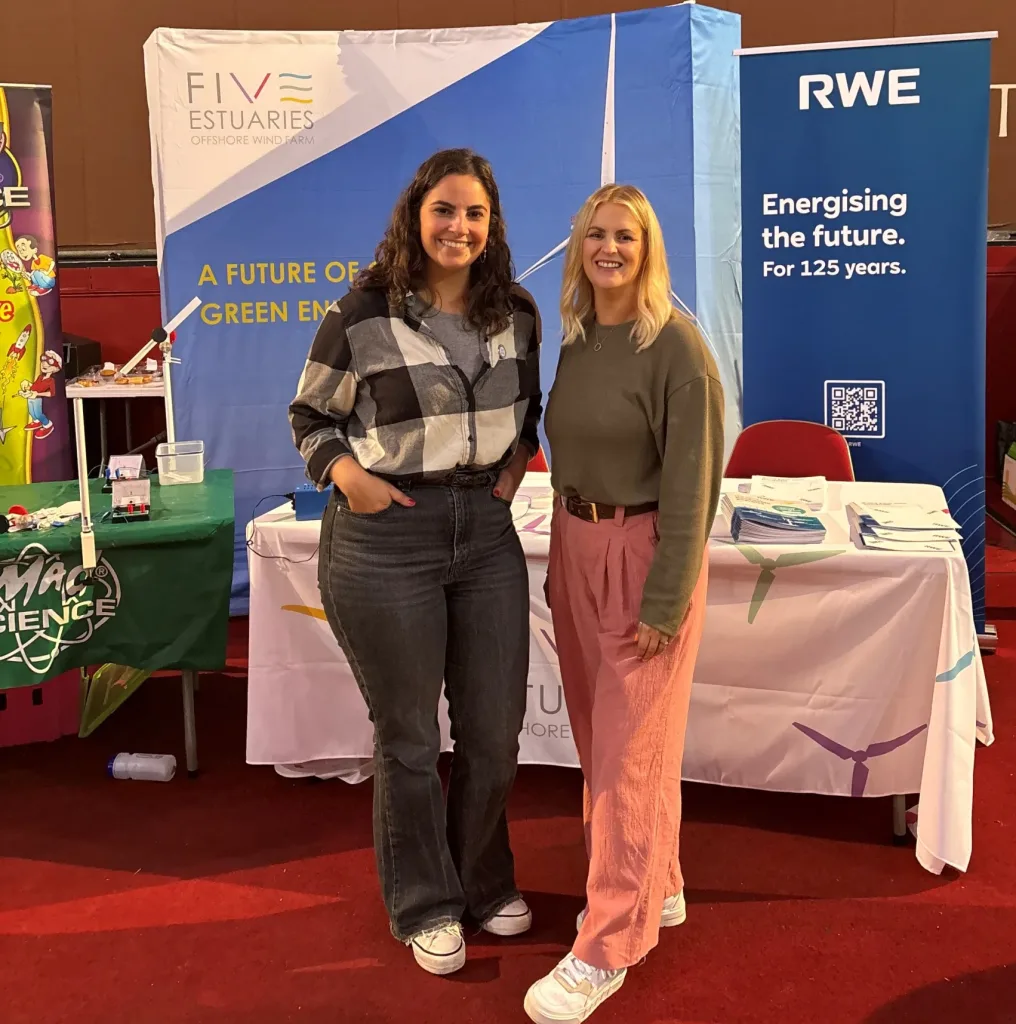

At the Essex Green Skills Fair, attended by approximately 2000 students aged 15 to 19, the Five Estuaries team was able to highlight the career possibilities within offshore wind and with RWE. As students start making critical decisions about their next steps — whether university, apprenticeships, or work-based learning — the fair provided an ideal setting to showcase how the skills they’re developing now can open doors in the offshore wind sector. By explaining the wide variety of roles needed — from electrical engineers to data scientists, marine biologists to project managers — the team highlighted just how many paths can lead to a rewarding career in renewable energy.
Information was provided on the different apprenticeships, undergraduate and graduate opportunities available through RWE. It gave students the chance to ask questions about the practical and technical skills required in offshore wind, offering insights into how they might tailor their studies towards a career in renewables.

The sector offers a multitude of pathways for young people with varied interests, and our ambition is to help them understand that working in green energy doesn’t necessarily mean working on a wind turbine. Careers in offshore wind can span technical, environmental, managerial, administrative, and even creative, with roles in areas like communications and engagement. By helping students understand these varied opportunities, the project seeks to build a local workforce ready to support a sustainable future.
These events are just the beginning of Five Estuaries’ ongoing commitment to engagement and workforce development in the local area. The project will continue to partner with schools, colleges, and career organisations to inspire and prepare the next generation of renewable energy professionals.
This September the Five Estuaries’ team were delighted to welcome Alex Cooksey to join the Project under the RWE Renewables Graduate Programme. Alex will be with the Five Estuaries team for six months, before moving on to other areas and projects within RWE over the 18-month graduate programme.
Hear from Alex below and how he spent his first few weeks at RWE and the Five Estuaries team.
Hi, I’m Alex! My first few weeks with RWE have been full on and varied, but great fun and a really good insight into RWE.
I started my first week in Essen, Germany at the RWE headquarters to take part in the graduate onboarding scheme. It was great to meet other graduates on the same programme from a variety of different countries. In my second week I joined a teambuilding sailing event in Portsmouth. Having never sailed before this was a chance for me to try something completely new and out of my comfort zone as well as meet some core members of the Five Estuaries team.

The Five Estuaries project commenced their Examination in September, so for almost a week I was with most of the team in Colchester as their first round of hearings took place. This is a key point in the Five Estuaries development process and was the perfect opportunity for me to meet members of the wider team and start to gain an in-depth view of the Project, insight into how the Examination process works and the next steps for Five Estuaries.
I also traveled to Dublin for the quarterly development meeting and gained a further understanding of various aspects of the Project and wider RWE organisation.

Before coming to RWE, I did a Masters in Sustainable Engineering because I am particularly interested in using renewables to reach the 2050 net zero target. Over the course of my degree, I felt myself having a growing interest in wind energy specifically. Upon returning from my industrial placement year, I began my dissertation which included researching ways to improve onshore vertical-axis wind turbine efficiency. Considering this, I decided the best route for me was to work in offshore wind and so applied for a position at RWE since it is one of the top three offshore wind developers in the world.
Before my Masters, my learning process began like everyone else’s with GCSEs, where I studied Triple Science, German, Geography and Product Design (PD) along with the mandatory subjects. I knew I wanted to go down the STEM career path, so I chose Maths, Physics, Biology and PD for A-Levels to keep my options open.
My results came as a shock, as they would not allow me to study Engineering at university and I received no offers from universities I had applied to in my final year. Despite this, I continued to study hard, in the end achieving 3B’s in Maths, Physics and Biology. Through clearing I was offered a place at Nottingham Trent University to study Biomedical Engineering. This was perfect since I was still unsure of my future career route, and this course combined all the subjects I had studied throughout my A-levels.

Covid-19 put an abrupt end to my second year, and for the remainder of my degree the course was conducted entirely online – not something you want when studying engineering. Although I attained a 1st class degree, I was still not sure what my next steps would be. I took six months out of education, working in a bar, and returned to the same university the following January to start my Masters in Sustainable Engineering; a field of engineering I am much more passionate about.
It has taken me six years in total to finish university. My advice to those that are just starting this journey is to take your time and make the most of opportunities and experiences when and wherever possible.
These past weeks at RWE have been full of travelling and new experiences and I am now picking up tasks and responsibilities within the Five Estuaries project. I’ve met a variety of colleagues from different departments, functions, and backgrounds. I have also been able to view the project from a project management perspective, allowing me to understand the challenges and opportunities with its development.
I moved to Bristol for this role having come originally from Bradford, West Yorkshire. The programme has promoted networking with other graduates, and I now regularly see colleagues inside and out of the office.
I am fortunate to be working on Five Estuaries during such an important period and the programme will expose me to other facets of the development process for offshore wind farms, which will be a great experience for my future career.
I am looking forward to seeing what the future holds for me at RWE. I hope that during my time here I will continue to work within a team-oriented culture where ideas are shared, and collaboration is encouraged. I am excited to be involved in and work on innovative offshore wind projects and initiatives that are at the forefront of the industry and supporting the UKs net zero targets.
RWE offer a range of graduate programmes for those looking to start careers straight after studies. Providing the opportunity to challenge yourself and find out which path you want to focus on as a business professional. Find out more below or the Renewables Programme Alex took via the links below. #TeamRWE
National Grid Electricity Transmission (Sea Link), North Falls (Offshore Wind Farm) and Five Estuaries (Offshore Wind Farm) have been working together to explore the potential for offshore coordination as part of the Offshore Transmission Network Review (OTNR) “Early Opportunities” workstream.
The projects, acting together in a consortium led by North Falls, were awarded funding by the Department of Energy Security and Net Zero (DESNZ) through the Offshore Coordination Support Scheme (OCSS) in December 2023.
On 28 March 2024, the consortium submitted a high-level feasibility study that formed the first step of the grant funding agreement. The study assessed the feasibility of a coordinated offshore connection specifically: the capital costs; building blocks; construction and commissioning methodologies and overall programme associated with a coordinated solution.
The Secretary of State for Energy Security and Net Zero has reviewed this study, amongst other information and has decided not to grant further funding to the consortium. The feasibility study identified that coordination is technically feasible however, it also identified:
Given the significant extra costs and the negative impact on the delivery timeline of connecting more renewables to the UK energy system, especially considering the government’s commitment to quadruple offshore wind and fully decarbonise the UK’s electricity system by 2030, the consortium supports the Secretary of State’s decision and will not be further pursuing a coordinated offshore connection. We would like to thank DESNZ for its continued engagement throughout the grant term.
*This figure is attributed to the constraint costs associated with an outage on Sea Link in 2032/33 only.
The letter outlines dates for the Preliminary Meeting and initial Public Hearings to take place near Colchester, as summarised below, with details on how stakeholders can participate in the examination. Further hearings will take place later in the year with the full examination timetable to be confirmed after the Preliminary Meeting. The Rule 6 letter can be viewed here.
Venue
The hearings will be held at the Wivenhoe House Hotel, Wivenhoe Park, Park Road, Colchester CO4 3FA. Subsequent hearings may be held elsewhere in the local area.
You must register in advance if you wish to participate, but anyone can observe the events either in person or livestream online, and a recording will be published on the project webpage shortly after the event.
For further information, please visit Five Estuaries Offshore Wind Farm – Project information (planninginspectorate.gov.uk)

Springpod is an organisation that works with schools, colleges, universities and employers to create interactive learning programmes which empower the next generation and enable them to take their future into their own hands by giving them equal access to opportunity.
The learning package is targeted at 13-18 year olds and includes videos and interviews with RWE team members. It allows students to explore the innovative world of offshore wind – from creating offshore wind farms to environmental factors and cutting-edge engineering projects. It also gives them valuable information about the various careers and pathways into RWE and the wider sector.
A key benefit of having this learning available online is that it’s convenient and accessible regardless of location. Physical work experience within offshore wind is sometimes difficult – so making the information and opportunities available on a virtual platform means that we can engage with a wider audience of young people.
The programme is available until May 2025 and young people can sign up for free to access the full virtual work experience package. It should take about 7-8 hours to complete and and be carried out at your own pace.
Those completing the programme will get a downloadable portfolio of their work and a certificate of completion which can be used to enhance applications for jobs, apprenticeships and UCAS personal statements.
Representations giving notice of any interest in or objection to the Application must be made directly to the Planning Inspectorate through the Planning Inspectorate’s Registration and Relevant Representation Form. This is available to be completed via the Planning Inspectorate’s website for the Project using the web address below.
https://national-infrastructure-consenting.planninginspectorate.gov.uk/projects/EN010115
Alternatively, if you would like to request a paper copy of the Registration and Relevant Representation Form, please telephone the Planning Inspectorate on 0303 444 5000. Completed paper forms should be sent to The Planning Inspectorate, National Infrastructure Directorate, Temple Quay House, Temple Quay, Bristol BS1 6PN. The Planning Inspectorate reference for the Application (EN010115) should be quoted in any correspondence.
The Planning Inspectorate’s Advice Notice 8.2: How to register to participate in an Examination (December 2016), provides further guidance on how to register and make a relevant representation and can be accessed via the following link: https://www.gov.uk/government/collections/national-infrastructure-planning-advice-notes
Relevant Representations must be received by the Planning Inspectorate by 11:59pm on Friday 21 June 2024. (Please allow enough time for delivery if submitting a representation by post.)
In submitting a representation, it should be noted that the personal data and correspondence relating to any representation will be made publicly available. If you do not wish personal data to be made publicly available, you should state why when submitting the representation. The Planning Inspectorate will publish the representations with your name removed, however, the representations may give them less weight during the Examination as a result. Please note that all representations submitted will be published on the Planning Inspectorate’s website and will be subject to their privacy policy, found online here: https://www.gov.uk/government/publications/planning-inspectorate-privacy-notices/customer-privacy-notice
The Application form and the accompanying documents, plans and Environmental Statement (including Non-Technical Summary) can be viewed and downloaded free of charge on the Project’s page of the Planning Inspectorate’s website under the ‘Documents’ tab:
https://national-infrastructure-consenting.planninginspectorate.gov.uk/projects/EN010115
The documents will be available online throughout the pre-examination and examination process.
The Non-Technical Summary of the Environmental Statement (document reference 6.1.5) and a Guide to the Application (document reference 1.3) will be available in the locations set out below until at least the end of the representation period (closing on 21 June 2024). The four libraries listed below also have public internet access, through which the Application documents can be accessed free of charge.
Location | Address | Opening Times |
Tendring Visitor Information Centre | Town Hall, Station Road, Clacton on Sea, CO15 1SE | Monday to Friday: 9am to 3pm |
Suffolk County Council Offices | Endeavour House, 8 Russell Road, Ipswich, Suffolk, IP1 2BX | Monday to Friday: 8am to 5pm |
Clacton Library | Station Road, Clacton-on-Sea, CO15 1SF | Monday, Tuesday, Thursday and Friday – 9am to 5.30pm Wednesday: 9am to 7pm Saturday: 9am to 5pm |
Frinton Library | 59 Old Road, Frinton-on-Sea, CO13 9DA | Tuesday and Friday: 9am to 5.30pm Thursday: 9am to 7pm Saturday: 9am to 5pm |
Greenstead Library | Hawthorn Avenue, Colchester, CO4 3QE | Monday, Tuesday and Thursday: 9am to 5.30pm Saturday: 9am to 5pm |
Manningtree Library | High Street, Manningtree, CO11 1AD | Tuesday: 9am to 5.30pm Wednesday: 9am to 1pm Thursday: 1pm to 7pm Friday: 9am to 1pm Saturday: 9am to 5pm |
The full suite of Application documents can be made available in printed format on request at a cost of up to £10,000. Requests for alternative formats (braille, other languages, etc) will be considered on a case-by-case basis. For all document requests, please contact Five Estuaries directly.
The project, which is being developed by RWE on behalf of the project’s partners (RWE, a Macquarie-led consortium, ESB and Sumitomo Corporation) now moves into the ‘pre-examination’ phase of the consenting process; with the examination phase expected to begin later in the summer and last six months.
Five Estuaries is a proposed extension to the existing Galloper Offshore Wind Farm. The new wind farm would be split across two separate seabed areas covering 128km2 in the southern North Sea and create enough energy each year to power hundreds of thousands of homes.
The project includes up to 79 turbines with a maximum tip height of 399m and would be located approximately 37km at its closest point off the coast of south Suffolk. Coming ashore at Sandy Point between Frinton-on-Sea and Holland-on-Sea in Tendring, Essex, underground cables then travel approximately 22km to a new substation located to the west of Little Bromley. Finally connecting the power to the proposed adjacent East Anglia Connection Node substation, part of National Grid’s Norwich to Tilbury Project.
All of the application documents are available to view on the project page of the Planning Inspectorate’s website at https://national-infrastructure-consenting.planninginspectorate.gov.uk/projects/EN010115. Anyone can register on the website as an ‘interested party’ to participate in the examination process, this is expected to open soon.
The examination is expected to take six months, followed by a three month period for the Examining Authority to make their recommendation. A final decision on consent, taken over a further three month period, will rest with the UK Secretary of State for the Department of Energy Security and Net Zero, and is anticipated in summer 2025.

National Grid Electricity Transmission (Sea Link), North Falls (Offshore Wind Farm) and Five Estuaries (Offshore Wind Farm) have been working together to explore the potential for offshore coordination as part of the Offshore Transmission Network Review (OTNR) “Early Opportunities” workstream. The projects acting together in a consortium led by North Falls welcome the decision from the Department of Energy Security and Net Zero (DESNZ) to provide grant funding through the Offshore Coordination Support Scheme (“OCSS”). The aim of the scheme is to develop and explore the feasibility of coordinated options for offshore transmission infrastructure.
The consortium applied for OCSS grant funding in February 2023. Following the grant announcement, the consortium will now undertake a series of studies and assessments to determine the feasibility, challenges and solutions to enable a co-ordinated offshore connection. This work will consider the economics, engineering & regulatory challenges, logistics and programme delivery aspects. The first step will be a high-level feasibility study which is expected to be available before the end of March 2024.
All three participating projects are delighted to have been awarded the grant funding. This support enables the projects to consider an alternative coordinated connection whilst, in parallel, continuing to progress existing radial proposals to ensure no delay in building the much-needed infrastructure to support the UK’s net zero targets (should the offshore coordination be determined as not deliverable). As beneficiaries of the grant, we will be required to share key learnings on how a coordinated offshore transmission approach could work.
The consortium strongly support the Government’s ambition to make the UK the world leader in offshore wind. The delivery of the UK Government’s ambition of 50GW of offshore wind by 2030 will create green skilled jobs, strengthen UK security of supply, provide clean renewable power to fight climate change and help to reduce energy bills for British consumers.
Keep in touch
| Phone: | 0333 880 5306 |
|---|---|
| Email: | info@fiveestuaries.co.uk |
| Write to us: |
Five Estuaries Offshore Wind Farm Ltd, Alexander House, 1 Mandarin Road, Rainton Bridge Business Park, Houghton Le Spring, Sunderland DH4 5RA |
© 2020 Five estuaries offshore wind farm
Registered in England & Wales 12292474
VAT number 347 5985 47
Powered by Steamboat Creative
