This updated partnership structure marks a significant milestone for the Five Estuaries project, bringing together a wealth of expertise in developing, financing and operating large-scale offshore wind farms globally.
Building on its strong presence in the region through the Longfield solar farm project in Essex and EDF UK’s operations at the Sizewell power station in Suffolk, EDF power solutions will lead the development in close collaboration with all project partners.
Five Estuaries Offshore Wind Farm is located approximately 40km off the north Essex, south Suffolk coast. The up to 1,080MW project received development consent in December 2025 following over four years of development. Once operational, it is expected to generate enough electricity to meet the equivalent needs of approximately one million average UK homes annually.
Matthieu Hue, CEO of EDF power solutions UK and Ireland, said:
“We are delighted to join our partners in the Five Estuaries Offshore Wind Farm project. This project perfectly complements our existing portfolio in the UK and Ireland. We look forward to working closely with our partners and local stakeholders to bring the project online and support the UK’s energy independence and security.”
Kunal Patel, Partner at Copenhagen Infrastructure Partners, said:
“Offshore wind offers the UK a golden opportunity to deploy clean, home-grown energy at scale, to lower and stabilise electricity bills, create highly skilled jobs as well as bolster energy security and deliver economic growth. CIP is delighted to be further expanding our UK investment portfolio through acquiring a stake in Five Estuaries Offshore Wind Farm, and we look forward to working with partners to deliver the project.”
Since the project received development consent, work has been ongoing to further the project design, start early procurement work and continue engagement with landowners, communities and other stakeholders.
Diane Mailer, who has led the project since November 2023 and now takes on the role of Development Director within EDF to take the project forward said:
“We’re delighted to welcome the new ownership group and look forward to working with such experienced and committed developers as the project moves forward. While ownership is changing, our commitment to the project remains firmly in place, including our focus on responsible development and maintaining strong relationships with our stakeholders and local communities as we progress towards delivery.”

EDF power solutions UK and Ireland is a subsidiary of EDF Group, one of the world’s largest low carbon electricity companies, and our investment and innovation is reducing costs for consumers and bringing significant benefits for communities.
With our operating portfolio of 50 renewable energy and storage sites including battery, onshore and offshore wind we are providing much needed affordable, low carbon electricity. To achieve our purpose of delivering, powering and shaping an Electric UK and Ireland, we have developed an expanding portfolio of private wire, wind, battery and solar projects with plans to reach 10 GW by 2035.

Founded in 2012, Copenhagen Infrastructure Partners P/S (CIP) is a global fund manager and leading investor in energy infrastructure. CIP builds value that matters by developing and constructing critical infrastructure projects that shape the future of energy.
Through its funds, CIP invests in power generation (solar and wind), energy storage, transmission and distribution, advanced bioenergy, low-carbon fuels and carbon capture.
With 15 funds currently under management, CIP is trusted by over 200 of the world’s largest and most sophisticated institutions, having raised EUR ~43 billion to date. CIP has projects in more than 30 countries, with presence on the ground through a network of +2,300 professionals.

ESB was established in 1927 as a statutory body under the Electricity (Supply) Act, 1927. With a holding of 97.1%, ESB is majority owned by the Irish Government. The remaining 2.9% is held by the trustees of an Employee Share Ownership Plan. As a strong, diversified utility, ESB operates across the electricity market, from generation through transmission and distribution, to supply of customers in addition to using our networks to carry fibre for telecommunications.

Sumitomo Corporation (TYO: 8053) is an integrated trading and business investment company with a strong global network comprising offices in over 60 countries and regions. The Sumitomo Corporation Group consists of approximately 500 companies and 80,000 employees on a consolidated basis. The Group’s business activities are spread across the following ten groups: Steel, Automotive, Transportation & Construction Systems, Diverse Urban Development, Communication Services, Digital AI, Lifestyle Business, Mineral Resources, Chemicals Solutions and Energy Transformation Business. Sumitomo Corporation is committed to creating greater value for society under the corporate message of “Enriching lives and the world,” based on Sumitomo’s business philosophy passed down for over 400 years.
The Design Guide will be provided to the commissioned substation designers, setting a fixed framework for the final substation designs. The purpose of the document is to:
We are grateful to the local community, our landowners and other stakeholders who have been vital to the development of the Design Guide and provided valuable insight to help shape the final document.

The Design Guide has been prepared to support the development of detailed proposals for both projects co-located onshore substations. Before the submission of their Development Consent Order (DCO) applications, both projects prepared ‘design approach documents’ to outline individual plans and to evidence the ‘good design’ followed, in accordance with the overarching national planning policy for energy.
This Design Guide brings together the two projects’ individual approaches and plans for their substation sites into one combined document. It will be the primary reference document for guiding the detailed design and delivery of the substations and associated infrastructure; the intention for it to be used consistently by all designers, consultants, and contractors involved in the project to ensure a coordinated, high-quality, and policy-compliant outcome.
The Design Guide is comprised of nine parts:
The development of the Design Guide was iterative, subject to review by key stakeholders, interested parties and an independent design review panel. This meant that the content evolved as stakeholder feedback was gathered, and the shortlist of options was refined.
Through two separate phases of engagement, we consulted local residents and landowners, parish councils and local authorities on the aspects of the guide that were subject to optionality.

Essex Quality Review Panel (EQRP)
The EQRP were the independent design review panel for the Design Guide. Established by the Essex Planning Officers Association in partnership with Place Services, their role is to ensure the delivery and promotion of high-quality new developments through the creation of good design, sustainability and improved quality, creating better places and environments to work and live in the County.
Internal Design Champion
The projects appointed RWE’s Head of Electrical, Control and Instrumentation, who has over 17 years of substation development and construction experience across multiple offshore wind farms. The Design Champion has overseen the internal design review process and retained overarching responsibility for design quality, assisted by an internal design review team.
Phase 1 took place in August / September 2025 and presented the first draft of the guide. We received valuable feedback and welcomed over 60 people to our public information day in Lawford. Phase 2 took place in February / March 2026, where we presented a refined and more technically focused document. Generally, consensus was achieved on the majority of the topics for which we presented options for during Phase 1, therefore, we were seeking comments on how we’ve interpreted the feedback received and how the Design Guide has evolved as a result.

Feedback from all our engagement and how the Design Guide has developed as a result is summarised below:
Options for adjusting the compound’s location within the overall site footprint were explored. Feedback indicated a clear preference that any reduction in compound land take should be focused on the south-eastern edge, enabling the provision of a wider belt of screening planting and enhancing visual mitigation.
This is noted in the Design Guide, should opportunities to reduce the size of the compound become possible through design efficiencies and the careful positioning of infrastructure.
Options for either a mono or dual pitch roof were presented. A clear preference was not determined, although other feedback expressed a desire for the OnSSs buildings to have as low profile as possible and for them to reflect local agricultural character.
Optionality for either a mono or dual pitch roof will be maintained at detailed design stage. The final guide introduces a dual pitch roof to provide a truer reflection of local agricultural vernacular and provides more flexibility in the siting of the substation buildings.
Feedback expressed a clear desire for the substation buildings’ elevations to embrace the local vernacular, wherever possible.
Due to the modular approach taken for substation buildings and need for a secure, watertight and non-flammable environment, the use of timber cladding cannot be considered. A change in sheet material (e.g. fibre cement / steel cladding), change in the orientation of panels (horizontal / vertical) or change in colour can be considered to emphasise verticality within the elevations.
Calls for materials to be as environmentally friendly as possible.
‘Lean’ construction, minimisation of embodied carbon and reuse/recycle of material to be prioritised within design.
Requests for sustainability to be considered in depth throughout the design in relation to climate resilience, carbon reduction and biodiversity.
A new chapter for sustainability was added to the second draft of the document. This detailed that a holistic approach to sustainable design shall be adopted, ensuring that sustainability is fully integrated into all aspects of the detailed design process.
A high level of support was garnered for the inclusion of sustainable design features.
The inclusion of each feature has been carefully assessed by the design and engineering teams and included in the final Design Guide.
Preference for chosen colours and materials to blend into the local rural landscape, including nearby agricultural buildings, as far as possible.
The focus of the design is on visual integration with subtle landscape and architectural colours, drawing on aspects of the ‘visual integration’, ‘accents’ and ‘foils’ concepts presented previously, with blocks of colour used against a neutral baseline to break up the massing of the substation buildings and relate to existing and proposed vegetation in the landscape.
General preference for planting to include a mix of native species and avoid species that suffer in drought.
The Design Guide sets out the landscaping principles that each projects appointed designers will follow in developing the final landscaping proposals and planting plans in response to the substation designs. It builds upon and refines the indicative proposals submitted as part of each project’s examination.
The Design Guide sets out the approach to be followed for the landscape design, including spatial arrangement and composition, screening, habitat creation and integration with surrounding land use. It uses established guidance and considers the Essex Local Nature Recovery Strategy. It recognises the importance of early, deep, multi-layered planting to mitigate visual impacts of the substations and any other future developments in the area. Planting and habitat creation to the wider site area shall replace and/or compensate for the loss or change in existing landscape elements, ensuring there is Green Infrastructure connectivity.
Request for consideration of how planting will be monitored and / or maintained.
The Design Guide sets out a list of preferred plant species for the final design to consider. The final landscape plan will include a long-term maintenance strategy to ensure the habitats and screening planting are successful.
Comments that planting to field boundaries could obstruct road user visibility and calls for appropriate road signage to safeguard against collisions.
It also identifies areas where planting may be prevented due to other infrastructure (such as overhead and underground cable routes) or to maintain access for landowners.
Feedback from the first EQRP review urged the projects to consider ways in which the wider community could meaningfully benefit from the development. Further feedback was gathered from the local community to better understand how the area is used for recreation and the ways in which the development might align with these uses.
Wider community and recreational opportunities are currently being explored through the Five Estuaries Substation Area Access and Connectivity Study. Further input is also required to understand any implications for site operation and security that may arise for anything that is proposed at the site.
The projects are currently in a phase of design refinement and early procurement planning. The Joint Substations Design Guide will be provided to the selected substation contractor/s, alongside other technical documentation to be used to inform the final detailed design.
What’s in this issue:
Five Estuaries is owned by various shareholders including RWE, which is leading the development of the project on behalf of the project partners. The offshore wind project is owned by RWE (33.33%), a Macquarie-led consortium (25%), ESB (20.83%) and Sumitomo Corporation (20.83%.)
An extension to the operational Galloper Wind Farm, the project is to be located in the southern North Sea across two seabed areas covering approximately 128 km². Five Estuaries is consented to comprise up to 79 wind turbines, with a maximum tip height of 370 metres, plus foundations.
Under the approved plans, electricity generated by the wind farm would be transmitted ashore via subsea cables to Sandy Point, located between Frinton-on-Sea and Holland-on-Sea in Essex. From there, underground cables will connect to a new substation west of Little Bromley, eventually joining the East Anglia Connection Node on the proposed National Grid’s Norwich–Tilbury transmission corridor.
Danielle Lane, RWE Director of Development for UK and Ireland, commented: “We are delighted to have received development consent for Five Estuaries. This achievement reflects years of dedicated community engagement and collaboration with local stakeholders.”
Once fully constructed, Five Estuaries would be capable of generating sufficient electricity to power the equivalent of up to 1 million typical UK homes annually. During construction and operations, the project would support hundreds of new and existing skilled jobs, both directly and across the wider supply chain. Strategically, the project could also play an important role in helping ensure UK security of supply of domestically generated clean power and support the Government’s transition towards a decarbonised electricity system.
We are incredibly grateful to all stakeholder organisations and communities that we have engaged with over the past five years as we have developed the project. We would like to take this opportunity to thank those who have helped us to refine and adapt the proposals to create the best possible project for this site, for the community and the environment.
You can view the Development Consent Order and supporting information on the Planning Inspectorate website here or see where you can view a printed copy here.
We are committed to working collaboratively with all stakeholders, local communities, and interest groups throughout the next phases of the project to ensure it delivers real value locally, regionally, and nationally.
We will continue to keep you informed as the project progresses into the construction and delivery stages. In the meantime, should you have any questions or wish to stay engaged with the project, please don’t hesitate to contact us.

What’s in this issue:
He explained that “this is to allow time to request further information that was not provided for consideration during the examination period and to give all interested parties the opportunity to review and comment on such information.”
We remain committed to providing all requested information to support the Planning Inspectorate and the Secretary of State as they complete their assessment.
We would like to thank all stakeholders, community members, and partners for their continued interest and support. Our overall programme to generate renewable energy for the UK by 2030 remains unchanged.
We will provide further updates as soon as more information becomes available.
To read the full statement, click here.
The works will be taking place within our proposed development boundary between Bentley Road and Ardleigh Road (as shown on the below plan), within the parish of Little Bentley, on private land in agreement with the relevant landowners.
Archaeological trial trenching involves the excavation of trial trenches across a site to estimate the archaeological potential.
The surveys will be taking place near Little Bromley 17 Public Right of Way; however, this will remain open throughout the works with fencing and signage as appropriate.
This is the second stage of trial trenching following those that we undertook within the proposed substation area in 2023 and will continue next year at other areas along the proposed cable route. This is not the start of either of the project’s construction as we are still awaiting consenting decisions.
The surveys are being carried out jointly by Five Estuaries and North Falls to help the projects understand the archaeology that is present to inform the next stage of mitigation, and whether any more detailed set piece excavations may be required (if significant archaeology is identified), which can be planned in prior to the main works starting. This approach is detailed in the Archaeological Mitigation Strategy: EN010115-001695-10.47 Archaeological Mitigation Strategy (AMS) – Revision B (Clean).pdf.
The locations of the trenches have been informed by using desk-based sources (such as aerial photography and existing records) and the geophysical surveys we carried out in 2023. The trenches target potential archaeology as well as blank areas to be explored.
The works are expected to take around six to eight weeks, being complete by mid-October, subject to weather conditions.
The works will be undertaken by our contractor Wessex Archaeology. The trenching will take place between 8am and 5pm Monday to Friday. All staff carparking will be located within the work area, or at offsite locations as agreed with landowners and designated accesses will be used. Equipment will be secured onsite when works are not taking place in agreement with the relevant landowners. The topsoil and subsoil will be segregated during the trenching, and the field will be fully reinstated on completion of the works.

What’s in this issue:
This May we’re going to be at the East of England Energy Group’s Southern North Sea Conference (EEEGR SNS2025) on 21 and 22 May 2025 at the Norfolk Showground. You can find us at stand 5 alongside North Falls Offshore Wind Farm.
SNS is a leading forum where industry, the supply chain, academia, and government connect with the whole of the energy sector supporting the East of England. The two-day event attracts over 1,500 attendees and enables up to 80 exhibitors to showcase their services. Presence at this flagship East Anglia event kick starts both projects supply chain engagement activity within Essex and the surrounding region.
We will be there to talk to suppliers about next steps, the procurement process and potential opportunities to work with us. Interested suppliers can book an introductory meeting via the below booking platform.
Five Estuaries & North Falls Offshore Wind Farms at SNS 2025 | Scheduling and Booking Website
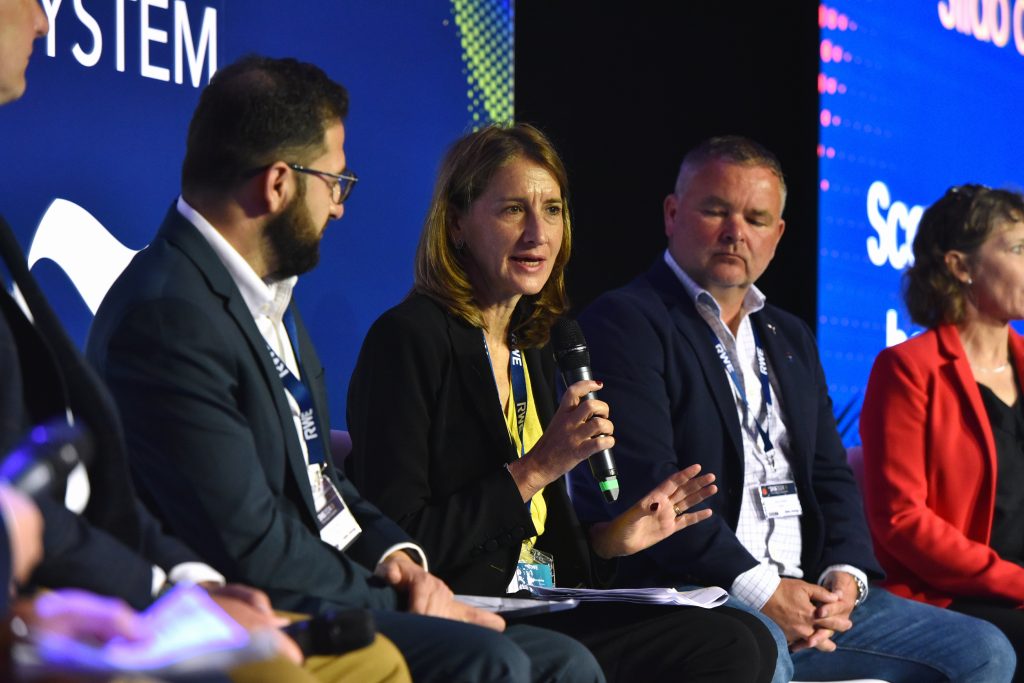
With positions spanning offshore wind technician roles, generation technicians, graduate schemes and year in industry placements. RWE is investing in the development of talent essential to achieving its Net Zero by 2040 ambition. These roles represent RWE’s commitment to building a skilled, diverse workforce to power a sustainable energy future.
RWE’s apprenticeship programme reflects the evolution of careers in the energy sector. From coal-generation apprenticeships over 50 years ago to cutting-edge training for offshore wind and green generation, RWE remains at the forefront of workforce development.
Tom Glover, RWE UK Country Chair, said: “Our apprentices are the future of RWE and are at the very heart of our ambition to be carbon neutral across all our operations by 2040. As we expand our clean generation capacity, these talented individuals will play a vital role in shaping the future energy system. Apprenticeships are not just about gaining skills—they are about building careers, transforming lives, and inspiring a new generation to help power the transition to a sustainable world.”
RWE currently has 75 apprentices across all programmes, below some of them comment on their career pathways.

Five Estuaries sister project Galloper Wind Farm is proud to have supported four apprenticeships through the Offshore Wind Turbine Technician apprenticeship programme to date and has another placement available this year.
Conor Nicholson, business and stakeholder coordinator at Galloper, said: “We are proud to have successfully led four talented students through the apprenticeship programme, helping them to kickstart their career in one of the UK’s fastest growing industries.
We look forward to receiving new applications in 2025 and giving someone the opportunity to begin an incredibly rewarding career.”
Apprentices are the backbone of RWE operations many achieving management positions. Madeline Warburton is a current Wind Turbine Apprentice with RWE, “Since joining the apprenticeship, I’ve had great support from my guide group and leaders who helped me grasp and learn different skills. Living and working alongside peers also means that there’s always someone looking out for you.
One of the highlights of my apprenticeship has been being nominated for one of the Young Energy Professional Awards, being the youngest person at the ceremony and seeing a lot of really strong female role models on the stage. I felt like I belonged.”
RWE’s recent apprenticeship programs have trained apprentices across the UK in roles ranging from wind technicians to software developers with the group making up more than 3% of RWE’s UK workforce. The company’s national offshore apprenticeship hub at Coleg Llandrillo in Wales, launched in 2012, remains a cornerstone of its strategy, having supported training over 100 offshore wind technicians.
RWE’s apprenticeship and graduate programmes are designed to equip participants with hands-on experience and professional development, offering a solid foundation for a lifelong career in energy. The initiative not only supports RWE’s growth objectives but also addresses the UK’s wider skills gap in the renewable energy sector.
The 2025 apprenticeship programmes will run between two to four years, combining hands-on training at operational sites with classroom-based learning. Candidates undergo a rigorous selection process, including assessment centres, team exercises, and interviews, to ensure the best talent joins RWE’s mission to create a clean energy world.
RWE has a dedicated online apprenticeship hub which includes all roles available and some helpful tips and advice for candidates. The company also offers a range of opportunities to add to people’s skills including industrial placement programmes, higher apprentices and fast-track generation technician programmes alongside graduate schemes.
Keep in touch
| Phone: | 0333 880 5306 |
|---|---|
| Email: | info@fiveestuaries.co.uk |
| Write to us: |
Five Estuaries Offshore Wind Farm Ltd, Alexander House, 1 Mandarin Road, Rainton Bridge Business Park, Houghton Le Spring, Sunderland DH4 5RA |
© 2020 Five estuaries offshore wind farm
Registered in England & Wales 12292474
VAT number 347 5985 47
Powered by Steamboat Creative
