To help with this, we have appointed independent consultants, Context Office, to carry out a study that will identify aspirations and opportunities to improve public access, wayfinding and connections in and around the substation area, into the communities of Little Bromley, Ardleigh, Lawford and Great Bromley, and beyond.
There are many workstreams associated with the development of the project, including further design work, procurement, skills and education programmes, supply chain engagement, construction planning and community funds. While the study will consider the current project design, it is being undertaken voluntarily and sits outside the development of the project and its consent requirements.
We hope the study will help identify and test opportunities before developing a strategic plan that delivers meaningful, long-term improvements for local communities and the surrounding area.
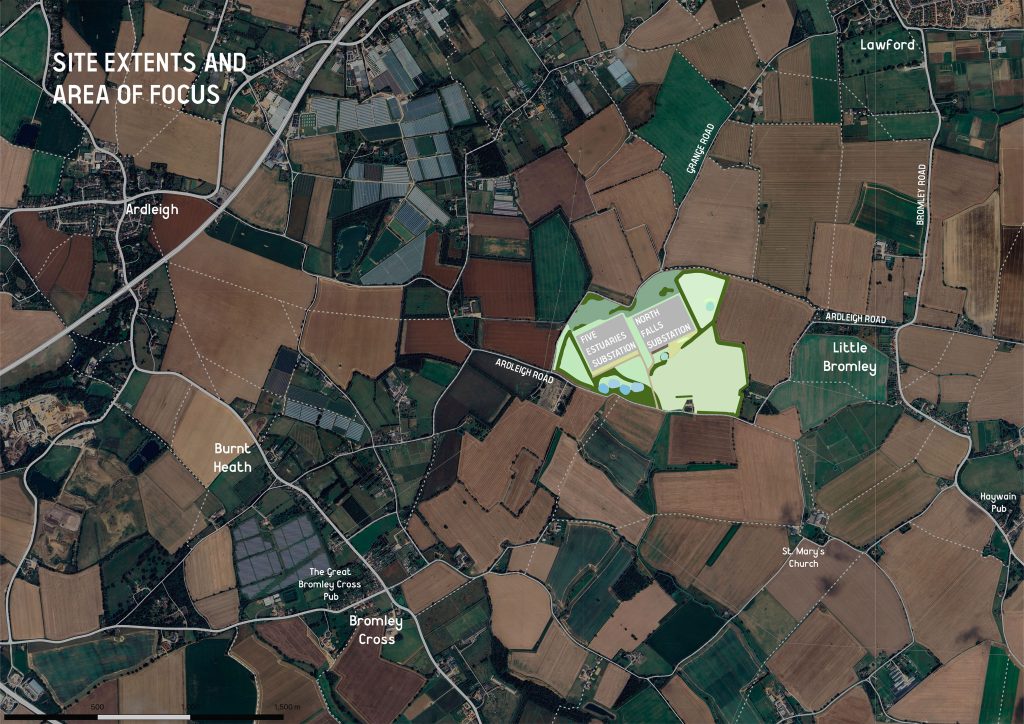
The study has been split into the following stages, which Context Office commenced at the start of 2026.
Desk-based research and site visits have been carried out to build an understanding of the area’s history, local character, current patterns of use, wayfinding and signage, walking and cycling routes, and other recreational activities and community infrastructure.
As part of our early fact-finding building, a range of individuals, local groups and organisations who currently use and have an interest in the local area have been identified and contacted. These include:
Context Office will then produce a concise document with recommendations, ideas and opportunities for public access, wayfinding and route improvements within and around the substation site for use by local people, as well as ideas for site interpretation features, wider landscape integration and potential interventions in the wider area. These proposals will be shaped by the site analysis and engagement findings.

If you or an organisation you are a part of, has an interest in the area in and around the substation site and we haven’t engaged with you directly already, we would love to hear from you. Getting to know as much as possible about the local area and how people use, or would like to use it, is extremely valuable to us.
You can contact us directly with any information, views or questions you have by emailing us at fiveestuaries@rwe.com. The areas we would like to find out more about are in relation to current use and aspirations and opportunities. Please let us know about what of these is relevant to you.
Current use
Aspirations and opportunities
Context Office are the independent consultants Five Estuaries has commissioned to carry out this study.
Context Office is a design and research practice specialising in public space. They provide surveys of place, insight on districts, cultural and spatial strategies and design solutions for streets and spaces.
The practice works with both public and private sector clients to help them make thoughtful and nuanced improvements to the built environment. Their approach involves the detailed observation of people’s use of space, the study of site-specific environmental, historical and future conditions, alongside consideration of stakeholder needs, policy and development demands. They interpret the forces that shape complex places in order to make proposals.
They are interested in urban, rural and marginal conditions, from celebrated spaces to overlooked places. They work with clients and partners to integrate new development and infrastructure, enable cultural activity, design characterful routes and build public spaces that contribute to sustainability and improve the quality of everyday life.
Five Estuaries is the furthest along in our development programme and therefore has the opportunity to explore additional pieces of work outside the design and build of the project that can support the local area.
We recognise that this study includes and could be beneficial to areas beyond just the Five Estuaries substation site and therefore are keeping the North Falls, Norwich to Tilbury and Tarchon Interconnector projects informed of our activity and will share information as it becomes available.
This study is early work to further our knowledge of the area and get to know more local stakeholders. The final report, to be produced by Context Office, will enable us to determine our next steps around further engagement requirements and inform the next stage of design development for the project.
The project may be limited in terms of what it can deliver independently, but will look to explore initiatives that can be supported, will share findings with local authorities to inform their understanding of local needs and the findings may help to inform the direction of the community fund.
The project is keen to engage with people and groups who use areas that may be affected by future construction activity. Through this study, we will identify who those users are, how they use these areas and when they are most frequently used. This will enable us to engage directly with those groups outside of this study as construction plans are developed.
The information gathered will help inform construction planning and identify opportunities to minimise disruption wherever reasonably possible, as well as preferred methods to keep you informed throughout the construction period.
No, this study is being undertaken separately from the project’s Community Benefit Fund. You can find out more about the Community Benefit Fund here. Findings from this study may help to inform the direction of the fund and understand early priorities.
Keep in touch
| Phone: | 0333 880 5306 |
|---|---|
| Email: | info@fiveestuaries.co.uk |
| Write to us: |
Five Estuaries Offshore Wind Farm Ltd, Alexander House, 1 Mandarin Road, Rainton Bridge Business Park, Houghton Le Spring, Sunderland DH4 5RA |
© 2020 Five estuaries offshore wind farm
Registered in England & Wales 12292474
VAT number 347 5985 47
Powered by Steamboat Creative
